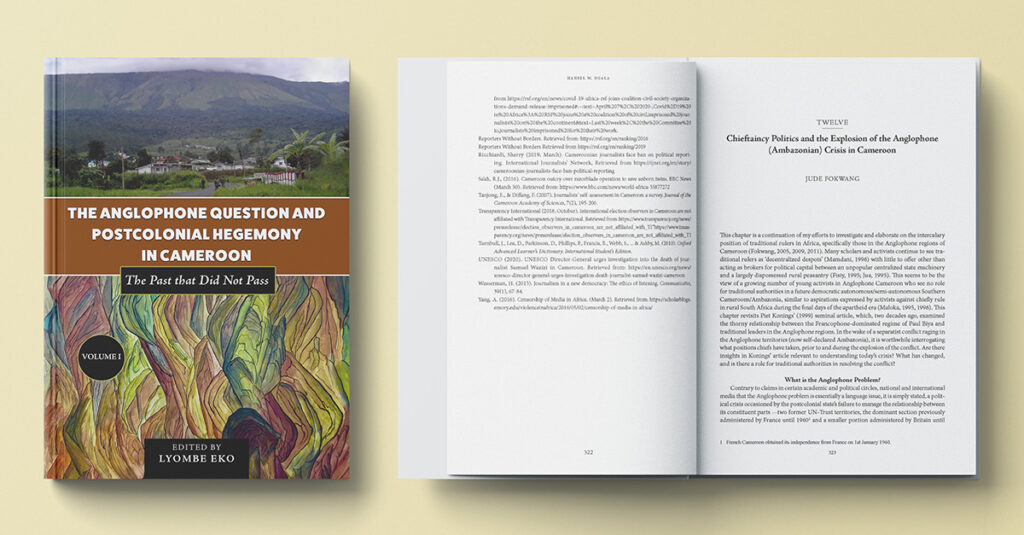
Fokwang, Jude. 2024. “Chieftaincy Politics and the Explosion of the Anglophone (Ambazonian) Crisis in Cameroon.” In The Anglophone Question and Postcolonial Hegemony in Cameroon: The Past that Did not Pass, edited by Lyombe Eko, 323-342. Denver: Spears Books.
Introduction
This chapter is a continuation of my efforts to investigate and elaborate on the intercalary position of traditional rulers in Africa, specifically those in the Anglophone regions of Cameroon (Fokwang, 2005, 2009, 2011). Many scholars and activists continue to see traditional rulers as ‘decentralized despots’ (Mamdani, 1996) with little to offer other than acting as brokers for political capital between an unpopular centralized state machinery and a largely dispossessed rural peasantry (Fisiy, 1995; Jua, 1995). This seems to be the view of a growing number of young activists in Anglophone Cameroon who see no role for traditional authorities in a future democratic, autonomous/semi-autonomous Southern Cameroons/Ambazonia, similar to aspirations expressed by activists against chiefly rule in rural South Africa during the final days of the apartheid era (Maloka, 1995, 1996). This chapter revisits Piet Konings’ (1999) seminal article, which, two decades ago, examined the thorny relationship between the Francophone-dominated regime of Paul Biya and traditional leaders in the Anglophone regions. In the wake of a separatist conflict raging in the Anglophone territories (now self-declared Ambazonia), it is worthwhile interrogating what positions chiefs have taken, prior to and during the explosion of the conflict. Are there insights in Konings’ article relevant to understanding today’s crisis? What has changed, and is there a role for traditional authorities in resolving the conflict?

Leave a Reply